




Showing posts with label diy pond aeration. Show all posts

Thursday, April 23, 2026

What Size Pond Aerator Do I Need?


Pond Aeration System Sizing & Kit Guide
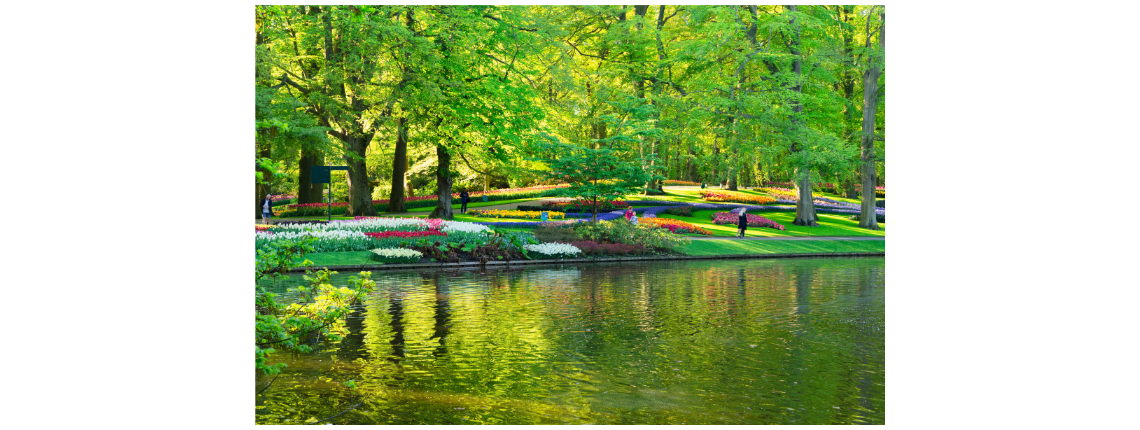
Choosing the right pond aeration system starts with three key factors: pond size, depth, and shape. For most ponds up to 1 acre, a linear diaphragm aeration kit is the most cost-effective and efficient solution.

What Size Pond Aeration System Do I Need?

Below is a generic sizing chart for ponds up to 1 acre. However, every pond is different, and shape is a major factor. We encourage you to continue reading to determine the best-sized pond aeration system for your pond.
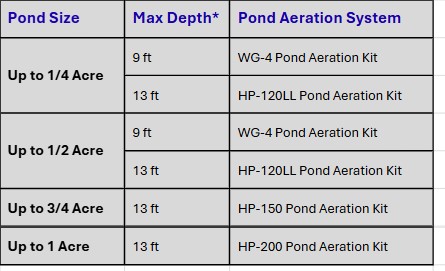
*Max depth is based on using HIBLOW’s Adjustable Height Diffuser at its highest setting of 3′

How does the pond shape impact system sizing?

There are two major advantages of subsurface (bottom-diffused) aeration over fountains and surface aerators. Subsurface aeration adds dissolved oxygen and creates water circulation from the bottom up. Water circulation is the most important factor. The goal is to move every molecule of water to the surface daily, or multiple times per day. At the surface, water absorbs oxygen and then cycles back to the bottom. This process eliminates stratification, allows toxic gases to escape, and evens oxygen levels throughout the water column. Oxygen supports beneficial bacteria that reduce muck, improve water clarity, promote fish growth, and help prevent algae blooms.

Choosing the correct number of diffusers is critical to mixing the entire pond. You may be able to use only one diffuser for a 1/4-acre round pond, but if a 1/4-acre pond is irregularly shaped with coves, multiple diffusers may be needed to ensure proper circulation. Additional diffusers may require more airflow and a larger pond aeration system.

Pond Aeration System Sizing Steps:

Step 1: Estimate how many diffusers you need to mix your pond, based on shape and size.
Step 2: Determine how much airflow each diffuser requires to “self-clean.”

Ensuring your diffuser does not clog is very important, as a clogged diffuser reduces airflow and puts stress on the pond aerator. Most diffuser manufacturers, including HIBLOW, recommend at least 40 LPM of airflow per diffuser. Read more about pond aeration diffusers here: Pond Aeration System Diffuser Options

Step 3: Estimate the total system backpressure.  Click here for step-by-step instructions:

How to Calculate Pond Aeration System Pressure


Calculating system pressure with HIBLOW’s Adjustable Height Diffuser:  

HIBLOW’s Adjustable Height Diffuser was designed to allow linear air pumps to be used in ponds as deep as 13′ (when the diffuser is set 3′ off the bottom). To calculate backpressure, depth is measured at the highest point of the diffuser. If the pond is 13′ deep and the diffuser is set 3′ off the bottom, the pressure calculation is based on 10′ of water depth.


Step 4: Using the pressure calculated in Step 3, review the pond aerator’s performance curve to estimate airflow. 
Step 5: Divide the LPM (airflow) estimated in Step 4 by the quantity of diffusers estimated in Step 1.

Does that number equal 40 LPM or more? If not, move up to the next size package.

Example:

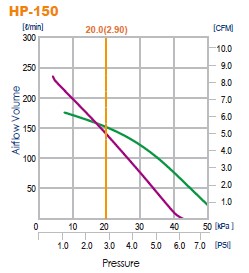
I estimated that three diffusers were needed to aerate an odd-shaped 1/2-acre pond. Based on the chart above, I am considering an HP-120LL Pond Aeration Kit. I calculated the total system pressure (see Step 3) at 4 PSI. Following the green curve below, the airflow at 4 PSI is around 90 LPM.

90 LPM ÷ 3 diffusers = 30 LPM per diffuser.

This is not enough airflow to “self-clean” each diffuser, so I likely need to size up to the HP-150 Pond Aeration Kit.

Need only two diffusers? The HP-120LL Pond Aeration Kit is sufficient, as you would get 45 LPM to each diffuser if properly balanced.
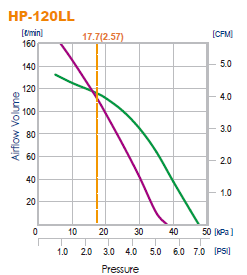
As you can see in the HP-150 graph below, the airflow at 4 PSI is well over 120 LPM. The HP-150 Pond Aeration Kit is the right choice.
HIBLOW Pond Aeration Kits Features and Benefits:

World Class Pond Aerator

HIBLOW pond aerators handle depth better than the competition, have the longest service life in the industry, and are easy to maintain. There’s no need to replace a HIBLOW pump when the diaphragms rupture after years of use. Simply rebuild the pump a few times in 20 minutes or less for a fraction of the cost of a new aerator. Pay a little more upfront to save time, hassle, and money in the long term.

Adjustable Height Diffuser (AHD)

The first of its kind, it allows HIBLOW aerators to be used at greater depths—historically reserved for rocking piston air pumps. Rocking piston pumps are effective for deeper bodies of water, but they are harder to maintain, noisier, and much less energy efficient—so why use them if you don’t have to?

Have an older pond or substantial muck buildup? Use the diffuser at its lowest setting of 12″ to prevent muck from stirring and circulating throughout the pond. The AHD is also excellent for winter pond aeration, helping maintain a hole in the ice while allowing for stratification so fish can take refuge in warmer water at the bottom.

2 and 3 Port Precision Control Manifolds

HIBLOW heavy-duty manifolds utilize gate valves that open and close gradually, allowing for precise airflow balancing. Most pond manifolds use quarter-turn ball valves, which provide only limited adjustment. HIBLOW manifolds also include a blowout valve to remove condensation from the airline. Condensation in the airline can create substantial backpressure, reducing airflow and stressing the aerator. Periodically close the gate valves and open the blowout valve to purge condensation.

High Quality Weighted Airline
Optional Accessories: 

Pond Aerator Cover and Manifold Valve Box

Learn more about all HIBLOW Pond Aeration Kits here:  HIBLOW Pond Aeration Kits
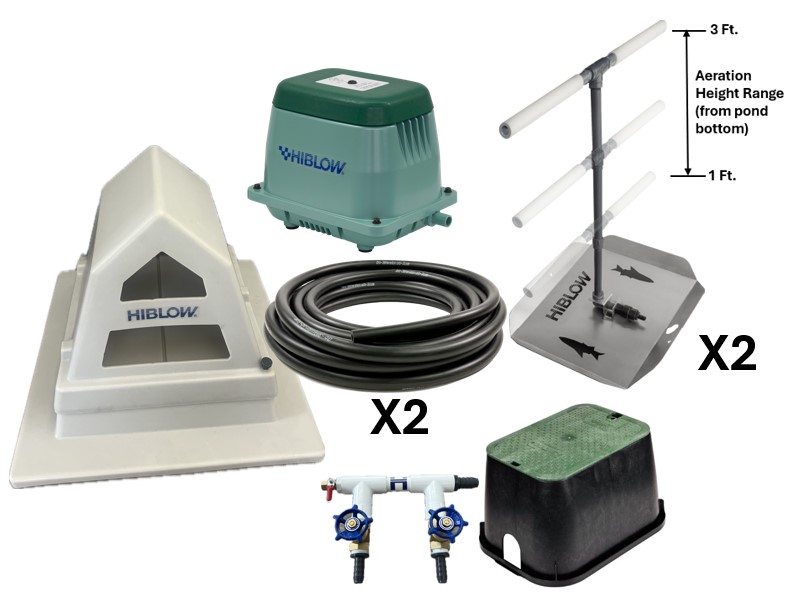
HP-120LL Pond Aeration Kit

April 23, 2026

Posted in:

Pond & Aquaculture

Friday, June 16, 2023

How to Start Planning for DIY Pond Aeration


Want to DIY your own pond?

Looking for the right type of diffuser and other equipment? 

We've got the info you need in our complete DIY pond aeration guide.

Choosing the Installation Location

If you are installing a solar system, then your aerator will likely be located right next to the pond.

If you are utilizing AC electricity, then there are a couple of options:

Running electrical power to the water’s edge:  We have heard of many folks hiring electricians and running power to the water; however, it can be very expensive considering the labor involved and the wire gauge needed to run long distances.

The most common (and recommended) location is near your electrical power source.  It is typically more cost effective to run tubing from your power source to the water’s edge – even hundreds of feet.

Choosing the best HIBLOW model:

Reference your notes on the size and depth of your pond and check out our article regarding choosing the best model and size air pump for your application.  https://www.hiblow-usa.com/2021/04/12/what-size-air-pump-should-i-use-to-aerate-my-pond/

Tubing Type and Size:

If you are planning on installing the aerator at the electrical source, it is most cost effective to buy PVC pipe, reinforced poly, or irrigation tubing and run that to the edge of the water.  If burying the tubing, make sure it can handle the weight of the earth or it may pinch which will reduce or eliminate air flow and put excess pressure on the pump causing it to fail prematurely.

Choosing the right diameter tubing is essential.  Generally, the longer the pipe distance, the larger the diameter of the tubing needs to be to reduce friction loss and limit back pressure.  Also, the more air flow (bigger the pump), the larger the diameter of the tubing needs to be.

Once to the water’s edge, weighted line is most often used, but not required.  Some folks choose to save money by running rigid PVC or flexible poly into the pond.  Of course, this requires bricks or cement blocks to weigh it down.

For detailed information on selecting the best tubing for your pond, please check out the following article: https://www.hiblow-usa.com/2020/06/16/what-size-and-type-of-tubing-should-i-use-with-my-pond-air-pump/

Diffuser Quantity and Type:

The diffuser sits at the bottom of the pond and produces microbubbles that rise to the surface.  HIBLOW typically suggests a medium bubble diffuser that produces sufficient air bubbles for oxygen transfer but also enough power to mix the pond.

Medium bubble diffusers put minimal backpressure on the air pump and “self-clean”.  However, fine bubble diffusers are sometimes the best choice if you have a shallow pond or are trying to grow certain breeds of fish.

The quantity of diffusers depends on your pond size and shape.  For instance, if you have a round pond that is 1/8th of an acre, you may need only 1 diffuser to turnover the pond.  If you have a kidney shape ½ acre pond, you may need 3 diffusers.  Most systems utilize at least 2 diffusers.

For help selecting the best type of diffuser for your pond, check out the following article:  https://www.hiblow-usa.com/2021/05/03/pond-aeration-system-diffuser-options/

We Can Help with DIY Pond Aeration!

Overwhelmed by the options and process for DIY pond aeration? We’re happy to help. If you have any questions during the process, please do not hesitate to reach out to us. Happy DIYing!

Thursday, June 1, 2023

DIY Pond Aeration: A Complete Guide

diy pond aeration

With careful planning and diligence, setting up an aeration system is manageable and can save you a significant amount of money if you do it yourself. Below is a step-by-step guide for installing an aeration system.

Planning for Installation

Determine Your Goal:

What are you trying to get out of your aeration system? Are you trying to reduce algae and other organic matter and improve water clarity?  Are you trying to increase the fish population?  If yes, what type of fish are you trying to grow?  Do they need a specific temperature to thrive?  Are you trying to prevent fish kill in the winter?  This information is important as we work through the set-up.

Power Source:

Choosing your power source impacts the balance of the installation.  Utilizing AC electricity is the easiest and often most cost-effective solution, certainly in the short-term.  However, sometimes electrical power is too far away.  In that instance, solar or wind power can be very effective, but the installation process becomes more complex, and the up-front cost is significantly more.  If solar is of interest, check out our article on DIY solar aeration: https://www.hiblow-usa.com/2021/06/07/diy-solar-pond-aeration/

Pond Size and Depth:

The size and depth of the pond is essential to understand before proceeding as it impacts which size and type of aerator you need, the diameter of the tubing, and the type of the diffuser.  Take careful measurements and note the shape of your pond.

Choosing Aeration Technology:

The 3 most common aeration technologies for homeowners are: fountains, rocking pistons, and linear diaphragm air pumps.

Fountains are visually appealing and provide some aeration to the pond, however they are considered surface aerators only pulling water from the top couple of feet.  They are often used in addition to subsurface aeration. They require a significant amount of energy, so are not typically powered by solar or wind.

Linear diaphragm air pumps and rocking pistons provide subsurface (bottom diffused) aeration.  Subsurface aeration adds dissolved oxygen to the pond, but most importantly, mixes the oxygen rich surface water throughout the water column.  The oxygen starved water at the bottom of the pond is cycled to the surface where it releases toxic anoxic gas into the atmosphere while absorbing oxygen.


We Can Help with DIY Pond Aeration!


Overwhelmed by the options and process for DIY pond aeration? We’re happy to help. If you have any questions during the process, please do not hesitate to reach out to us. Happy DIYing!

HIBLOW USA Exhibiting at 2026 OOWA Conference

  HIBLOW USA is excited to be exhibiting at the 2026 Oklahoma Onsite Wastewater Association (OOWA) Conference on September 15th and 16th! S...